
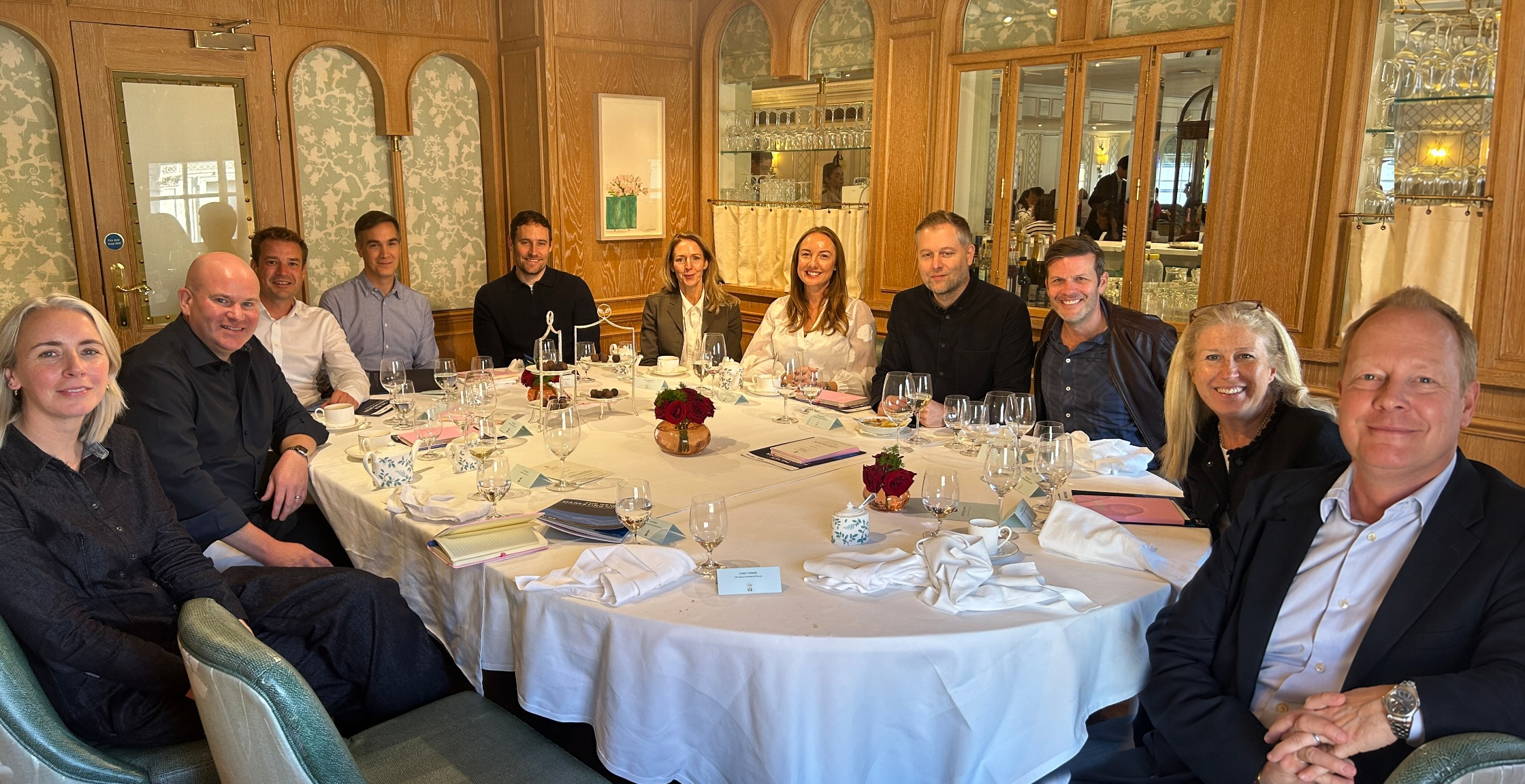
From content engines and AI governance to agency remuneration and the changing role of the CMO, our latest roundtable hosted by Flock and Grace Blue explored the decisions marketing leaders face as they look towards 2032.
To mark the launch of our latest whitepaper, 2032: The New Marketing Order – The Talent and Tech Redistribution, we brought together senior marketing leaders to discuss how technology is reshaping marketing organisations and the capabilities needed to drive growth.
The whitepaper draws on a survey of 66 senior marketing leaders from advertisers and agencies. Its findings provide a useful backdrop to six themes that emerged from the discussion. Download your copy here.
1. What brands should own in their content engines
What should brands build, buy or rent to create effective content engines?
Participants explored how brands can increase production capacity without creating unnecessary complexity or losing access to specialist expertise. How can they access innovation without becoming too reliant on one partner? And what skills, investment and career opportunities are needed to support greater in-house production?
Our research ranked Content & Production first among the nine capabilities for expected AI impact by 2032, making decisions about where this work sits, and who delivers it, increasingly important.
2. Governing AI and helping teams adopt it
How much freedom should teams have to experiment with AI, and where should organisations create firm guard rails?
Attendees discussed the tension between encouraging innovation and maintaining control over quality, data and brand standards. As AI agents become more embedded in marketing workflows, subject-matter experts will play an important role in training, monitoring and improving them. Clear accountability and well-designed workflows help teams understand where they can experiment and when human review is needed.
As part of this, change management is essential for adoption. People need to understand how a tool helps them, have time to practise on real tasks and receive support as their roles and routines change. Our whitepaper identified that organisations are acquiring tools faster than they are changing their skills, processes and data foundations. Investment in the people and processes around AI needs to keep pace with investment in the technology.
3. Creativity, AI and the importance of talent
If every organisation has access to similar technology, what will make one brand stand out?
Our round table discussion repeatedly returned to creativity, experience and human judgement. AI’s contribution can extend beyond production into developing ideas and helping assess likely customer responses. The challenge for marketers is to use those insights critically, bringing brand knowledge, cultural understanding and creative ambition to decisions about which ideas to pursue and test.
There were concerns raised about how the industry develops future talent if technology takes on more of the work traditionally used to build experience. Teams will need deliberate opportunities to practise judgement, learn from experienced colleagues and understand why work succeeds or fails.
In our research, Creative Ideas & Experience Design ranked seventh out of nine capabilities for importance in 2032. That raises a question about whether creativity is receiving enough attention as organisations focus on automation.
4. Rewarding outputs and outcomes
AI is prompting a rethink of how agencies should be paid. Participants questioned whether traditional time-based models adequately reflect value when technology can significantly reduce the effort required to deliver work. Output-based fees offer one response, while linking remuneration to business outcomes, such as growth and market share, creates a stronger connection between agency reward and client success.
Participants noted that agencies are increasingly willing to commit to outcomes, particularly when pitching. The challenge is to translate those commitments into workable agreements, with clear targets, agreed measurement and a fair assessment of what the agency can influence. See Flock’s latest thinking on the topic of outcome based fees here.
5. Testing agency technology capabilities
Agencies are making increasingly ambitious claims about their AI capabilities. But how can clients establish what those tools actually deliver?
A practical suggestion from the roundtable was to put the technology to the test during the pitch process. Clients should ask to see the tools in action, working through a live brief together to understand what the technology delivers, where its limitations lie and how human expertise improves the results.
Asking specific questions can also help establish how far a tool is embedded in everyday work. How many people inside the agency actively use its own agentic workflow tools, and what proportion of the intended users does that represent? How often are they used on live client work? What evidence shows improvements in quality, speed, cost or outcomes, and against what baseline?
These questions put practical evidence behind the demonstration. They also reflect our whitepaper’s call for stronger measurement of AI adoption and value, so clients can assess the benefits relevant to their own business.
6. The evolving role of marketers and the CMO
Our discussion closed with a broader question – what does success look like in 2032?
As technology takes on more executional work, marketing leaders will need to focus increasingly on growth, organisational design, commercial outcomes and the capabilities their businesses need. Several participants stressed that transformation cannot simply be delegated. Leaders need to understand the technology, challenge existing ways of working and help their teams navigate change.
Our research ranked Enterprise Leadership as the most important marketing capability for 2032. Growth & Value Creation ranked second for importance, but only seventh for expected AI impact. The role of the CMO may evolve, but the expectation is clear, marketing must demonstrate its contribution to business growth.
Looking ahead
The questions raised around content, governance, talent and agency relationships are not separate challenges. They are all part of rethinking how marketing operates.
For Flock, getting the balance right across people, partners, procurement, processes, and data and technology will be critical to building marketing organisations that are both more efficient and more effective.
The decisions leaders make now will determine how effectively their organisations can respond to the changes ahead. For leaders considering where to start, the priority is to identify the capabilities most important to growth, assess where the gaps are and build a joined-up plan for talent and technology. Flock can help shape that plan and support its implementation. If you’d like to continue the conversation, get in touch with the Flock team by filling out the form below.
Thank you to everyone who joined us and contributed to the discussion.
Explore the findings in our Flock x Grace Blue whitepaper, 2032: The New Marketing Order – The Talent and Tech Redistribution
Contact us